Showing posts with label the Rolling Stones. Show all posts

July 14, 2020

Stones Dig Goat's Head Soup from Their Vault

Goat's Head Soup deluxe reissue cover art. 

The Rolling Stones are taking the Clorox wipes to Goat's Head Soup.


Last week The Estate announced the upcoming deluxe reissue of the Stones' underrated 70s album, with a new look and new tunes. The deluxe version, available September 4, includes an extra disc with 3 unheard outtake tracks, instrumental versions, and 3 Glyn Johns original mixes.


"Criss Cross," the defacto single, is grimy, street-walking rock and roll.


It would fit right between "Can You Hear The Music?" and "Star Star" to finish the album on a high groove. "Scarlet" and "All The Rage" are the other titles.

Goat's Head Soup is one of -- only one of in a long edifying list -- their loosest, druggiest, but also, most heartbreaker of an album. It's equal adrenaline and inner ache.

Goat's Head Soup assembled in the ether during their second major output of productivity--


--the tailend of the 60s into the early 70s. It was their third of 3 consecutive yearly releases: the incredible excess of Sticky Fingers in 1971 and the infamous double-LP Exile on Main Street in 1972.

The Stones started recording the album at the end of 1972 in Kingston, Jamaica. The fresh locale seeped into the sessions with various percussion, trumpet, saxophone, piano and a range of instruments that skitter along with the band. "Dancing With Mr. D," "Doo Doo Doo Doo Doo (Heartbreaker)," and "Can You Hear The Music?" are the some of the Stones' sexiest, excessively 70s songs. Jagger screams raw exacerbated flesh. Richards cuts jags of aural delusion.


To counter the craze are other more melancholic songs from the group's catalogue.


"100 Years Ago," "Coming Down Again," "Winter," and of course, "Angie," find the group in contemplative remorse, nearly ballad, soul-bearing territory. Together it's a great set of songs, an emotional pinwheel.

Another surprise hides in the unreleased tracks. "Scarlet" features another legendary guitarist, Jimmy Page, from Led Zeppelin. Page has had a few run-ins over the decades with the Stones. That tends to happen with megastars hitting fame at the same rate. He laid down some guitar for the song "One Hit (To The Body)" that would end up on the Stones' 1986 album Dirty Work. As is usual with the Stones, there are numerous variations of the album and its iconography for sale. Browse here.

Original album cover art.

March 27, 2020

Bob Dylan Sings About a Past American Era


Bob Dylan, the man myth legend and hopefully healthy & safely quarantined songwriter has released another epic storysong.


"Murder Most Foul" is Dylan's first release in eight years and appears to be another offering of good tidings from a musician in this strange moment in history. The timing is perfect, because this song is nearly 17 minutes and hardly a second passes without a lyric. This will be one to unravel.


"Murder Most Foul" comes together with some cautious piano playing.


Dylan utilizes a small elemental band to swirl around him, each member in differing modes of winding up or down, on a slow jazz rush. The drummer comes in splashing the cymbals with brushes, a violin bow slices up and down, piano keys bristle.

Seconds in Dylan breaks through with that old gremlin growl of his. "It was a dark day in Dallas, November '63," he sings, "A day that will live on in infamy." In the song, Dylan plays out the gruesome assassination of John F. Kennedy, the 35th President of the United States--the most heinous and still unsolved event in the country's history.

"They blew out the brains of the king / Thousands were watching, no one saw a thing."


He forcefully describes the scene, offering possible motive. "You got unpaid debts, we've come to collect." Dylan sometimes plays loose with the facts in his songs, so I wouldn't allude to him having any Secret Service knowledge, but you can't say there's no wisdom in that grumble. The scene continues, through the limousine ride, arriving at Parkland hospital to Vice President Lyndon Johnson's swearing in to office on the tarmac in Air Force One.

Dylan drafts a direct line between the country's need to heal in the aftermath and the eruption of the counterculture. "The Beatles are comin', they're gonna hold your hand," he tells us before examining the remaining years of the 60s and 70s: Woodstock in the Aquarian Age, Altamont, Tommy can you hear me? I'm the Acid Queen. It's all "a party beyond the Grassy Knoll," Dylan sings. Colorful references of the time are dropped throughout, but Dylan brings each verse back to that fateful day in Dallas when the country broke.


Most listening to the entirety of "Murder Most Foul" will be encyclopedic Dylanologists and will love it.


It's just always a blessing to hear the master's voice and know he's breathing somewhere in a recording booth. But this is special because he sings about his contemporaries during another American era.

Everyone else might find it hard to keep their interest apace. There is no shift in tempo, no change in instrumentation, no real chorus aside from the lyrical sequence ending with the song's title, and Dylan shuffles lines over every measure. But, what else is there to do? Play it and listen. Dylan's last album was Tempest in 2012.

January 15, 2020

BOOK REVIEW: "You Can't Give It Away On Seventh Avenue -- The Rolling Stones And New York City"

On this earth, few things reach the level of unmistakable greatness in their category.

There is no greater city than New York. There is no greater band than the Rolling Stones. Bring the debate, you won't get far.

In the book, Can’t Give It Away on Seventh Avenue -- The Rolling Stones And New York City, author Christopher McKittrick gives a blow-by account of the intertwined histories of “Fun City” and the band. He attacks it like Melville describing the intricacies of dealing with whale blubber in Moby Dick. There is mention of not only every show they played in the city, but also shows band members saw in the city and hopped on stage for, tour announcements, recording sessions, the shows of solo tours, of ex-members and of the differing setlists played during multi-night stands.

Diehard fans will love all the details.

Jagger exasperates Truman Capote, ending his career as a rock journalist. Wood appears on stage to play with Chuck Berry, Bob Dylan and Tom Petty & the Heartbreaks in the summer of ‘85. While recording Dirty Work in 1985 Lower Manhattan, the band’s studio had a revolving door. Led Zeppelin’s Jimmy Page, Tom Waits, Bobby Womack and Don Covay were all in the area and made contributions to the album. There are countless short quips, musical icons paling around with musical icons.

Rifling through the newspapers of the time, McKittrick gives the pulse of the New York City press. The band have long held hero status; it’s hard to imagine critics ever writing off any of their previous work, but they did. Skeptical from day one, due to the group arriving on the heels of the Beatles, the press rarely gave the band all-around high praise. Their early antics never helped. When McKittrick highlights venues they played, he’ll continue with a full-forward history of the place, its changes and renovations, up to its current form of use.


What’s interesting here, outside of most accounts of the Stones, is the period in the early-80s to the mid-90s.

Jagger and Richards were at odds over solo careers and, in real-time, the band always felt a step from dissolution. For much of that time Jagger, Richards, Woods and even Watts with his jazz ensemble, lived and recorded in the City, sometimes merely blocks apart.

The underrated Tattoo You, released in ‘81, is actually a collection of scrapped demos leftover from the previous year’s Emotional Rescue. They wouldn’t work together as a unified force in the studio until Steel Wheels in 1989. The Jagger-Richards split was most visible during 1985’s Live Aid Philadelphia concert. Practicing for the gig in Manhattan, Jagger sung with Hall & Oates, while Wood and Richards played with Bob Dylan. McKittrick shows how creatively active these individual musicians were, even though the group was on a downturn.

It’s fascinating how the Stones’ history aligns with New York City’s.

From its clean-cut early days into the seedy 70s and 80s, then transforming into the big business arena it is today. New York City and especially Times Square is today the world’s number one family-friendly tourist vat and headquarters for much of the entertainment world. Likewise, the Rolling Stones have tidied up an image that survived Altamont, shifting musical ideologies like disco, punk and hip-hop, infighting and a wilting music industry to reign as the world’s touring juggernauts and writers of our history’s most important music.

McKittrick gives a gift to lifelong Stones fans with this book, a sort of bibliography of the facts and hard figures that have accumulated with legend. Can’t Give It Away is McKittrick’s first book. He writes about film and music for a number of outlets and lives in Los Angeles, though he is a native New Yorker.

Go further with IMP’s interview with Chris McKittrick from 2019 here.

September 04, 2019

The Rolling Stones in the Desert Again


The Rolling Stones in the desert again.

Growing up my house had a constant shuffle of rock and roll classics playing. My father, mother and I all have our Venn diagram of favorites. My dad and I love Pink Floyd, John Mellencamp, Neil Young. My mother not so much. My mom and I love David Bowie, Prince, Talking Heads. My dad might make a face. Led Zeppelin shifted my life, but they never had the patience.

The one band we’ve always been able to agree on, though, is The Rolling Stones. They've been the musical anchor, the baseline of understanding for family. Mick, Keith, Ronnie, Charlie, Daryl, Bernard, Chuck, are like an extension of that family. So when the Stones announced their 2019 No Filter North American Tour, and Arizona was on the itinerary, my mother, master of ceremonies, scooped up three tickets on the floor, economic future be damned.

Originally scheduled for May, the Arizona date, along with the entire tour had to be postponed for Mick Jagger's impending surgery to replace a heart valve.

Deep breath. A mere six weeks later, new dates were set and the recovering patient and his cohorts were set to hit Arizona in late August, a brutal time for non-dwellers, much less a couple of geriatrics from London. Proof that the coolest rock and roll band of all time has only gotten stronger with age.

"It's 120 [degrees] on the tarmac," Wood said on his Instagram, "We've just arrived in Arizona." One saving grace of this show being rescheduled in August was that State Farm Stadium has a closeable rooftop. The AC was pumping beautifully early on, until for some asinine reason, the roof opened right before showtime letting the day's heat just fall right in. In addition to being a complete clusterfuck trying to find your seats, the venue was not prepared for the crowd.


This was the Stones' first show in Arizona in over a decade and they played just as many songs.

Rock and roll may be big business for them now, but there is no denying the pure joy emanating back and forth from the stage. Jagger, still, post-heart surgery, at 76, is the antithesis of a frontman. No one comes close, and long as he's breathing on this earth he will prove that with all the might of a carpenter ant lifting 20x its weight. Jagger made use of every inch of the stage, left to right, and down the constructed catwalk starting from the lightning bolt opener, “Jumpin’ Jack Flash.”

It's absolutely astounding. There he is, in tight black pants and black tee, just as he was on the Steel Wheels tours 30 years ago. It's one thing to play a stadium show of hits for the fans; it's another fucking level to continuously maintain the energetic output and entertainment value of the past half-century. You cannot find any difference in the moves by Jagger between 1969 and 2019. Tom Jones, Roger Daltrey, Steven Tyler still lay it all out on the stage, but they are nowhere near tapping the energy of their heyday. Jagger, and the whole band, are legends, not only of rock and roll, but of gracefully allowing age in.

Ron Wood leapt around on stage like a teenager who just discovered power chords.

He jumped-kicked and squatted into full-on guitar god stance, rocking to and fro like some insect seconds before an attack. Wood always had a big grin on his face. His graciousness and excitement hurled from the stage. He was on a trip, and how could you not be, when, still inside you're just a boy from the London Borough of Hillingdon playing guitar for screaming, crying, out of breath fans in a monstrous metal dome in the American desert in a state called Arizona?

After Jagger introduced the band, Richards took over the mic for, "You Got the Silver" from Let It Bleed and "Before They Make Me Run" off Some Girls. Hearing the 75-year-old sing, "I gotta walk before they make me run," was soberly motivational. Keith played guitar like a drunk child, ecstatic and proud to be on two feet. Richards moved the most carefully of the group, but still stepped into every iconic stabbing riff.

The main foursome, Jagger, Richards, Woods and Watts sauntered down the catwalk, each in deep single shades of silk cloth, for a miniset above the floor crowd.

This has been a staple of their shows for at least the past two decades. It brings them that much closer to the adoring crowd. Armed with acoustic guitars, Wood and Richards eased into two classics, "Sweet Virginia" followed by "Dead Flowers."

Charlie Watts held it down all night, keeping the engine running while "Midnight Rambler" churned down to a slow palpitation. Whenever Watts appeared on one of four giganto screens his lips curled into a big smile, his eyes closing bashfully.

While their setlists on this tour have been about 60% identical, what's really a joy are the songs that differ state to state.

Arizona fans were treated to one of their first hits, "Let's Spend the Night Together," followed by the opener from an album two decades later, "Sad Sad Sad" off Steel Wheels. Jagger played the guitar like he was chopping wood. The song, from the ‘80s, still shreds.

The vote song was the way-back classic, "Get Off of My Cloud," from 1965, now reconfigured as an old man punk vamp that could've been recorded during Some Girls. Later in the set was the very state-appropriate song, “Paint It Black.” Jagger swiped through the heat that had settled singing, “I wanna see the sun / blotted out from the sky.” Richards’ and Wood’s jangly chords tangled with each other like electric sitars while Watts pounded the snare until the crowd went dizzy.

And of course they played the hits.

“Miss You” broke down into a lurid disco trot with Daryl plucking up and down on the bass. “Brown Sugar,” “Honky Tonk Women,” “Satisfaction,” all the classic raucous anthems erupted. “Sympathy for the Devil” and “Gimme Shelter,” continue to find relevance in the current day; the latter being the most ironic performance for this tour.

The Rolling Stones No Filter Tour, the group’s 47th traveling affair, was forced to reschedule twice due to two different hurricanes developing in the Atlantic. They were caught in it, but continued on. When the rain fell Jagger just spun faster, Keith hammered on, Ronnie yelled louder and Charlie pounded harder. It’s already etched in history, but the Rolling Stones keep proving they are the greatest band of all.

July 17, 2018

REVIEW: Celebrating David Bowie March 7

When planet earth lost its Starman David Bowie in 2016 the landscape went dark. The man was gone. But, for the rest of us, thankfully, his music remains locked in digital space and in our heads.
     Celebrating David Bowie, the touring tribute, features some of Bowie’s closest collaborators and friends. The concert is a reminder of the musical reach Bowie had, working with numerous musicians over his career to realize his creative concepts that would help define rock and roll’s kooky androgynous side.
     Each show on this tour has had its unique lineup making this far different from a cakewalking tribute band with no real connection to the star. The group that performed in Mesa, Arizona at the Mesa Arts Center on March 7 in the Ikedea Theater had representation from many of Bowie’s colorful eras.
     Mike Garson started playing piano for Bowie with 1973’s Aladdin Sane and acted as host of the night’s festivities. Earl Slick played guitar on Diamond Dogs, Young Americans, Station to Station, Heathen, Reality and The Next Day. Guitarist Gerry Leonard worked with late-career Bowie and bassist Carmine Rojas toured with him in the eighties.
     Filling out the rest of the stage was British musician Mr. Hudson and Joe Sumner, who fronts Fiction Plane (and is very clearly the spawn of Sting). They traded vocals on a few songs and added extra guitar and percussion. Holding down the drums throughout was Lee John Madeloni, Slick’s son.
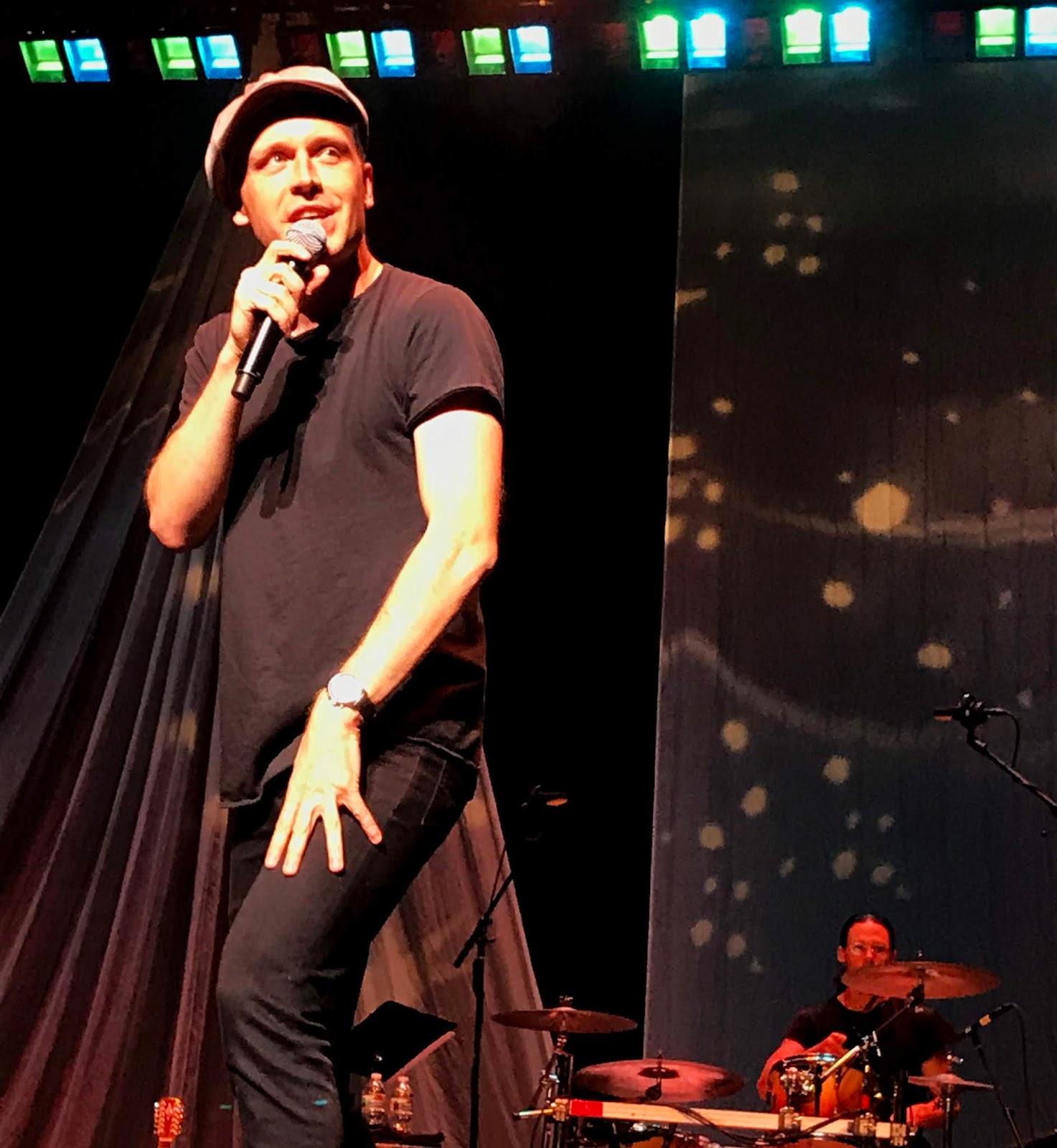
     But the big surprise, sauntering from the back shadows of the stage, after the first song, “Disco King” began, was Bernard Fowler. (above) Longtime Rolling Stones fans will recognize him instantly as part of the back-up team to Mick Jagger’s melodies the past few decades. On this night he took on a majority of the vocals. Fowler stepped out and proved his strength and agility as a front man. He moved with the music, rose his hands into the air, shook hips and leaned down into the front row to kiss a girl who’d been standing.
     Fowler then blasted through “Rebel, Rebel,” “Fame,” and “Moonage Daydream,” during which he leaned far over the stage, pointing to his eye like a manic soothsayer. “Keep your electric eye on me, babe,” he screeched, “put your ray gun to my head.” He milked the spotlight and performed every lyric. Yeah, Fowler got his Jagger on.
     It’s telling that it took three accomplished singers to match the vocal range of one man. But, each found their niche in Bowie’s scale. Sumner had the operatic power of eighties Bowie holding notes for entire sheets of music. Hudson nailed early, very British, coy Bowie on “Starman,” “Changes,” a heart-stopping “Five Years,” and others. Fowler had the power to reach Bowie’s full-throated emotion and lower register and at times sounded eerily like the man himself.
     At the midway point the group dropped in “Win,” the only track from 1975’s Young Americans. Fowler sang syrupy and charged lurching into the depths of debonair Bowie. Masterfully representing Bowie’s cocaine era, Slick (below, left) took the lead on “Station to Station” with a crumbling wall of feedback that oozed into the crunching stomp of what was the introduction of a new persona. “The return of the Thin White Duke,” Fowler sang, low in the sound, “throwing darts in lovers’ eyes.”
     A real treat was Garson getting candid, adding insight into songs and telling stories, humanizing the icon. For example, the time, 1973, when Bowie fell on stage leaving the band to wonder if it was part of the act, or decades later, when a rare brush with backstage nerves from Bowie saved the show from electrical misfire and sure embarrassment. Pride and sadness weren’t far from each other when Garson spoke these stories of his friend.
     For “Aladdin Sane,” Garson explained, Bowie wanted something extra out of bounds. He then went into the whirlwind piano that weaves through the song. This version, played decades later, was spot on and warped into a long batty outro with every other musician winding to a halt to witness Garson pound on the keys in hypnotic isolation. Then came “Ziggy Stardust” with Mr. Hudson (above, center) on vocals and the crowd went to their feet for the rest of the night.
     Sumner powered a chunk of the crowd to take over the front rows with “All the Young Dudes” to end the set. Then they returned and hit us with an encore of “Andy Warhol,” “Life On Mars,” “Diamond Dogs,” and “Heroes.” The idea for Celebrating David Bowie first sprouted in January 2017 with a one-off show to celebrate Bowie’s 70th birthday and to mark one year of his passing. The loss of icons doesn't come easy, but at least with David we now know for certain, there's a starman waiting in the sky.

**
"Disco King"
"Rebel Rebel"
"Moonage Daydream"
"Fame"
"Changes"
"Space Oddity"
"Conversation Piece"
"Starman"
"Win"
"Rock and Roll Suicide"
"Five Years"
"Let's Dance"
"Jean Genie"
"Station to Station"
"Lady Grinning Soul"
"Aladdin Sane"
"Ziggy Stardust"
"Suffragette City"
"All the Young Dudes"

encore
"Andy Warhol"
"Life on Mars"
"Diamond Dogs"
"Heroes"